Curriculum
MODULE 3 - Functional Competencies
Unit 1 - Be prepared be organized! Organizational skills
0/8

Unit 2 - Networking & Partnering
0/9
Unit 3 - Managing relationships with providers
0/8
Unit 4 - (Self-)management for Social Entrepreneurs
0/8
Unit 5 - Social impact measurement & assessment
0/8
Unit 6 - Managing time & resources
0/8
Lesson
Organizational skills, what are they?
While there is no universal definition for this concept, we can all agree on some basic elements. Organizational skills are the abilities that help you stay focused on different tasks, keep tabs on them, use your energy, time, physical space and mental capacity etc. effectively and efficiently in order to achieve the desired outcome. But is it enough to keep your schedule, have a clean workspace and stick to deadlines to be called organized? Or there is more? And more importantly, can you learn to be organized or you have to be born with it?
First of all, organizational skills are transferable, by that we mean you can learn these skills and you can teach them as well. They are soft skills also, which means that it characterizes a person’s relationship with other people, it is part of someone’s personality. For example, in case of an enterprise even if you have a good product, you know how to run a business but you are having a hard time when it comes to selling it, negotiate with buyers, then it won’t work properly. The same is true if you are unable to organize your days and the activity of your enterprise.
Since it is a personality trait, organizational skills are not position dependant, being organized will be natural in your personal life and your professional life, no matter if you are an employer or employee. And while they are important for every employer it mainly has two reasons, an organized employee is an efficient and an effective employee. An efficient employee is going to spare you money and help you innovate your enterprise. Eventually you will notice he/she is working on solutions for how to achieve the same or better results with less work/effort or how to reduce expenditures. In case you want efficient employees you have to pay attention to traits like is he/she always open for personal/professional development, optimistic and open minded? An efficient worker’s performance is impeccable and not only performs good with little supervision but willing to take additional responsabilities too. An effective employee gets things done by time and won’t give up in case of failure. You can recognize effective employees by characteristics like professionalism, integrity and honesty, ambition, flexibility but most importantly an effective employee is always keeping an eye on the goal, or on the mission of the enterprise.
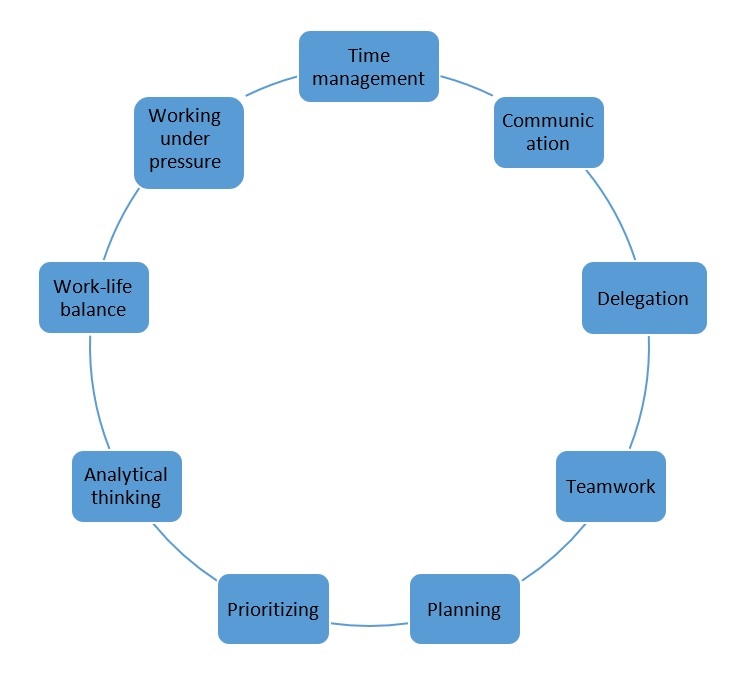
There are many organizational skills, we often see in people’s CV’s. The list below is not complete, we just mention the most common ones. Further on we will present these in more detail:
Time management:
Maybe this is one of the most crucial components of the organizational skills. Time managament is the ability to perform your tasks in a timely manner, schedule, and stick to deadlines. Managing your time is important because it helps you conserve your energy and stay calm in a fast-paced environment. Deciding when and how to use your time is a fundamental element of workplace organization. Without proper time management the constant workplace pressure and tasks can cause the collapse of a business, ruin someone’s personal life or have serious effect on the mental health. Even if your „natural” time management skills are unstatisfactory or almost non-existent, you can learn those through soft skill trainings. The first step is to develop a daily routine, place the repetitive elements/tasks on your agenda. Experience when you are more productive, that way you can schedule important tasks for that time. If you are unable to do it alone then try to use your phone, there are multiple applications which are supposed to help you manage your time wisely. If, for some reasons it doesn’t work out, you can always use other services for this purpose.
Communication:
Since we mostly organize our world through speech, we construct our daily reality through it, it is also an important organizational skill. Your communication skills are based on how well you share and receive information in the workplace. If you are an organized communicator, you will be able to give other members of your team the information they need in an effective and timely manner. Organized communicators prioritize efficiency in the workplace by responding to requests quickly, giving instructions accurately and relaying information reliably. Disorganized and hectic communication will damage your productivity and your business. You must speak and write in a clear manner to be sure your message is understood. This means your communication skills and active listening skills must be up to par to achieve success in the workplace.
Delegation:
In many cases, being organized means knowing your limits. If an employee’s/employer’s responsibilities become more than they can handle, they may need to assign one or more of their tasks to a coworker. An important part of delegation is knowing which team member/co-worker/subordinate is the most qualified to finish a particular task or project. If you can list and organize your tasks and decide which to delegate, you may be able to improve the productivity of your entire team/enterprise. In fact, delegation skills are related to teamwork skills. Well-organized individuals know what they can do themselves, and what they need to delegate to other team members to achieve the best results. It also shows, that you have a strong set of interpersonal skills.
Teamwork:
Teamwork as a skill cannot be interpreted in isolation, it only makes sense when accompanied by other abilities, like communication, delegation, cultural sensitivity. Organizing work in a group of people is just as essential as selecting the right people to build a team in the first place. If your organizational skills are up to the required standard, you’ll be able to put together a functional team and achieve synergistic results while boosting your leadership skills. And since Aristitle, we know that „Man is by nature a social animal” or translated into a much more contemporary wording, humans, by their nature are social beings, so it can never be a problem if you are a team player.
Planning:
We can easily say that the most important part of a well-organized undertaking happens before anything else even takes place. The ability to plan is undoubtably the most important attribute of any person who posesses strong organizational skills.
Prioritizing:
Being able to give priority to your tasks is far more important than checking off items on your to-do lists. If you can’t identify roadblocks ahead, break complex projects into smaller components and assess their impact on the outcome, then you will have to work on your ability to do it because managing a business is all about priorities. But working in the service sector you probably already know, that your number one priority is always the costumer/guest.
Analytical thinking:
Analytical thinking involves the ability to read and interpret information to come to reasonable conclusions. Being organized at work often involves organizing your thought process. Being able to think about a problem logically and determine the source of the issue will help you overcome setbacks quickly and avoid delays.
Work-life balance:
Efficiency at work starts with a good night’s sleep and fresh mind. Organize your mental and physical hygiene so there’s room for everything else too. It is also important from an emotional point of view to not to overwork yourself. Leave your negative feelings at home or at work, don’t project them to your employees or family members. Of course, it’s easier to talk about it than to do it, it requires good mental health and even external help in some cases.
Working under pressure:
Organizational skills are particularly important in high-pressure situations. In fast-paced environments and workplaces that enforce strict deadlines, being organized is critical so the employees are staying calm and focused. In the course of your operation, you may run into financial, administrative or legal difficulties. Difficulties like dealing with financial deficit or facing apathy from the part of target groups for example. These situations can involve a lot of pressure, to tackle them properly you have to schedule your time effectively, manage your energy and use your resources with creativity. That way your social enterprise is going to be a success story.
The presented case study, the Sándor family’s enterprise draws our attention to the importance of organizational skills indirectly. Because while the interviewee doesn’t necessarily talk about the above mentioned skills, the story he told allowed us to conclude that organizational skills played a key role in making the business successful.
During the lesson you might have noticed that most of the skills we named are basically in complementary relation or they build on each other, like LEGO. For example, in the case of work-life balance, you won’t have a good night’s sleep, if your time management skill is not adequate and you fall into bed late. Or time management, which is a core ability, is almost useless without proper prioritization. The point is, you can’t cut corners when it comes to your skillset, some of us are natural planners, some of us are not, the most important is to keep an open mind and be ready to learn.