Curriculum
MODULE 3 - Functional Competencies
Unit 1 - Be prepared be organized! Organizational skills
0/8

Unit 2 - Networking & Partnering
0/9
Unit 3 - Managing relationships with providers
0/8
Unit 4 - (Self-)management for Social Entrepreneurs
0/8
Unit 5 - Social impact measurement & assessment
0/8
Lesson
What is time management?
Time management is a way to maximise the efficiency with which we use our time to achieve our goals. It helps us to find focus and to be aware of what we are focusing on, when and for how long. If we don’t plan our time well, not only can we miss out on relaxation, but important things can easily get pushed to the back burner.
There are two misconceptions about the time that most people have: one is that we think that at some point in the future we will have more time. The other is that we can save time. We can’t reduce time, so there is no saving in any case, hours pass with maximum utilisation and doing nothing. One thing we can control is how we spend the time available, with what activities. Time management is nothing other than self-management. Consequently, time management is primarily about our personal efficiency.
Let’s reveal our own time management habits!
Each daily activity can be ranked according to the dimensions of urgency and importance. The four-way division along these main axes is called a time management matrix.
The characteristics of each activity window:
- Important: Activities that are in line with our values, our mission, and with our most important goals. This can be interpreted on a priority scale.
- Urgent: Activities that require immediate action/reaction. This can be interpreted on the time scale.
| Urgent | Not urgent | |
| Important |
I. Urgent and important = Do it!
critical situations, crisis situations, urgent problems, deadlines
must be dealt with immediately, in person |
II. Not urgent but important = Plan ahead!
activities to prevent critical situations, building relationships, looking for new opportunities, planning, activities to support self-development, learning, etc.
time and resources should be allocated to these tasks
|
| Not important |
III. Urgent but not important = Delegate!
dealing with things that have come up, unexpected calls, certain appointments, meetings, impending matters, things to avoid conflicts, etc.
these tasks should be done as time allows, or preferably delegated |
IV. Not urgent and not important = Delete!
Routine tasks, pretend activities, (trifles) regular occupations to procrastinate, irrelevant phone calls, information overload, mere pastimes, extra activities not intended to recharge, etc.
these tasks are deleted during the prioritisation process!
the window of time-wasting habits |
Time matrix
Stephen R. Covey: 7 Habits of Highly Effective People, 1999.
The table helps us to see which group of activities in the past days or weeks we can categorise according to how urgent or important they were to ourselves. Based on the predominance of each window, the following types of people can be distinguished:
Quarter 1: Urgent and important
- they spend a significant proportion of their time solving urgent and important problems,
- in their most urgent and urgent time, they have urgent and important issues to deal with, typically meeting deadlines,
- often feel they have no free time,
- they tend to be stressed in their daily lives.
Quarter 2: Important but not urgent
- opportunities, not problems, are the focus,
- effectively prevents crisis situations from developing in the course of your work,
- effective self-management.
Quarter 3: Urgent but not important
- tries to complete urgent tasks that are not important to him/her,
- satisfies short-term goals for the recognition of others or in place of others,
- typically completes his own tasks at the last minute.
Quarter 4: Not urgent and not important
- most of their activities are neither important nor urgent,
- when someone spends too much time in the first quarter, they tend to seek respite here.
Is there a correct ratio between the quarters? Ideally, the split would be as follows:
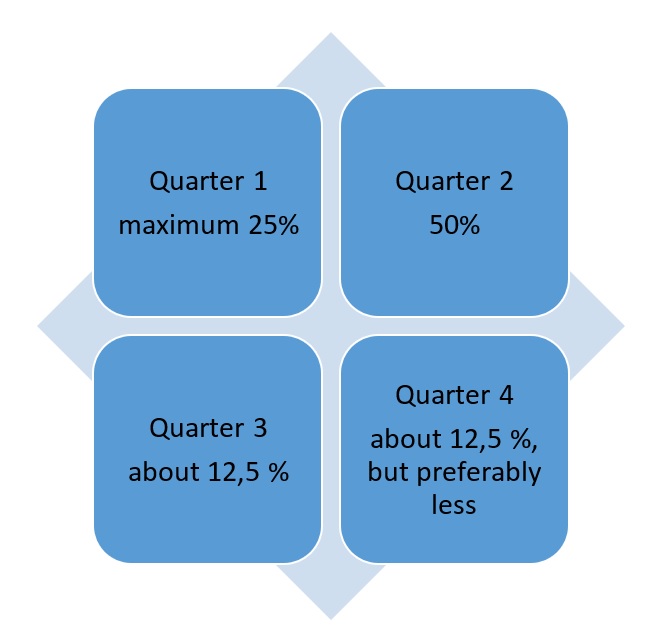
In good time management, it is important to squeeze as much time as possible into activities that are not urgent but serve your long-term goals. They are not immediate, of course, but they are essential for the future.
Types of time management:
Notes, checklists:
The use of notes and checklists is recommended to keep track of, collect and organise each activity.
The disadvantage is that prioritisation is not achieved in this case, typically post-its, handwritten notes are used to record the tasks to be done, which are later crossed out to indicate the tasks completed. This method is not suitable for prioritisation on the priority and urgency axes.
Calendars and time management diaries:
This method focuses on time planning by collecting activities and setting deadlines for them. It focuses on time scheduling and planning.
Prioritisation:
Prioritisation focuses on day-to-day planning, the list of goals to be achieved is prepared with the knowledge of the goals to be achieved, as it focuses on achieving results. Some tasks are worth spending more time on because they serve long-term goals. This could be a meeting, public appearance, etc.
Planning
Planning is both a task, thinking ahead and setting long-term goals, but it can also save considerable time. Spending 10% of your time planning and thinking through your tasks can save hours. The values we live our lives by and the roles we play in our daily lives (e.g. wife/mother, husband/father, etc.) are the foundation of the productivity pyramid and must be aligned with our goals to feel that our lives are worth living.
The productivity pyramid
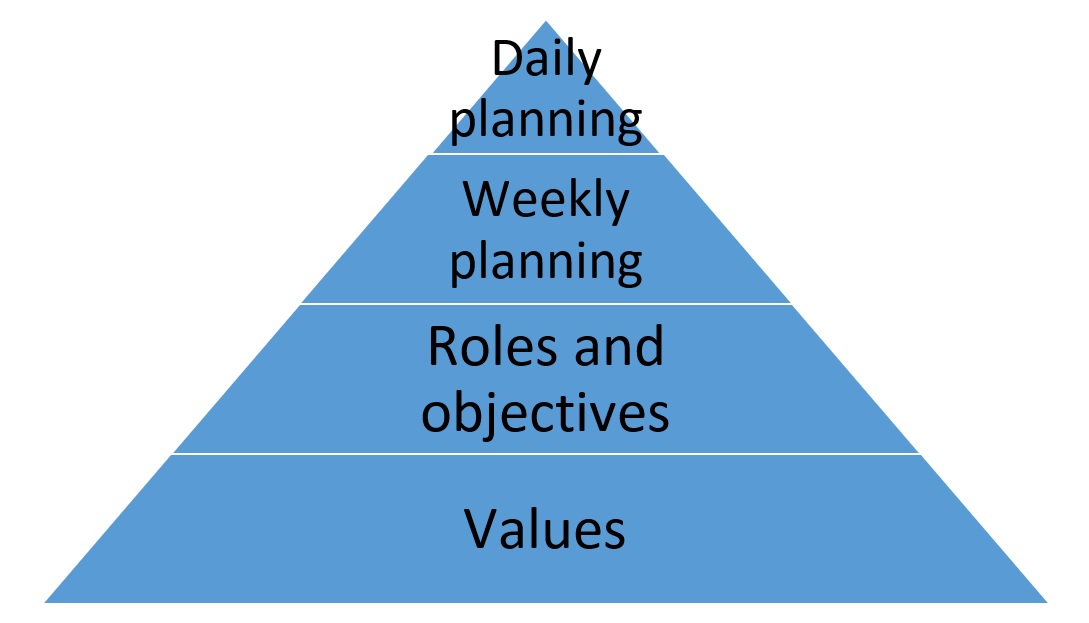
We can develop our own system of effective planning in our daily lives, where we finish our daily work at a predetermined time and focus on leisure activities, family and friends. Set a target, e.g. you can get work done by 5pm and be satisfied with your performance for the day. It’s important that we can do this without feeling a constant time pressure during the day.
Thoughtful planning requires setting priorities:
- identifying which tasks are top priority, which are secondary and which are not particularly important,
- the highest priority tasks are tackled immediately,
- always focusing on the task at hand.
All this helps to:
- don’t multi-task, don’t split up your work,
- don’t lose track, don’t get lost between tasks,
- don’t let the really important tasks take a back seat.
How do we prioritise?
- Define goals
- Collect tasks
- Prioritise
- Prioritise by urgency
- Set priorities
- Determine time requirements
- Determine timeframe
The ability to say no:
To make time for the activities that really matter to us, we need to learn to say no. The ability to say no is one of the most important time-saving factors, so every manager must learn to use it. Sometimes even for ourselves, even when there are many arguments for saying yes. Of course, it is unfortunate if we use it too often, and even less so if we only say no to certain people in all cases. Yet we do not have to do everything we are asked to do immediately. Before you say anything, feel free to ask for time: “I need a few minutes/hours, days, etc. to think about it.”
Human Resource Management:
The essence of human resource management is to plan the allocation of tasks, monitor their implementation and quality. In a multi-staff organisation, paying attention to this is essential and contributes greatly to increasing efficiency and achieving a balanced work ethic. Planning takes time, of course, but delegating saves more than that.
Adequate quality and performance require expertise, and assessing this is essential. We need to identify what our colleagues and associates are best at and delegate tasks accordingly.
Delegation:
The delegation has many advantages. One of them is that it frees up time to deal with much more complex problems by delegating routine tasks to others. Another advantage is that we motivate the person we assign a task to. It can also be a way of providing experience or broadening opportunities for subordinates.
Preliminary assessment:
- Definition of the task and objectives.
- Definition of objectives and expected results.
- Selection of the right person (suitability, experience).
When discussing the task with the staff member:
- Defining the characteristics of the task (deadline, means, quality requirement, powers).
- Checking understanding of the task, handing over tools, personal support, checking cooperation.
During the implementation of the delegated task:
- Monitoring the performance of the task, requesting feedback on performance, preparing a report if necessary.
When the task has been completed:
- Evaluate performance, share feedback.