Curriculum
MODULE 3 - Functional Competencies
Unit 1 - Be prepared be organized! Organizational skills
0/8

Unit 2 - Networking & Partnering
0/9
Unit 3 - Managing relationships with providers
0/8
Unit 4 - (Self-)management for Social Entrepreneurs
0/8
Unit 5 - Social impact measurement & assessment
0/8
Unit 6 - Managing time & resources
0/8
Lesson – What is Networking?
According to co-founder of social enterprise Profound Gentlemen, Mario Jovan Shaw, networking may be defined as “obtaining social capital”. This idea refers to the ability to convert professional/business relationships into useful assets for our organisation, as an instrument to get access to valuable resources namely skills, technical advice and finances especially the start-ups (Malaki, 2015; Brady and Haugh, 2007)).
In this sense, networking is one of the most important personal skills for any business and, especially, for (social) entrepreneurs who are just starting out and will need to establish lasting relationships with other entrepreneurs or with experts who can provide support, knowledge, etc. In essence, networking is an activity whose main objective is to expand and consolidate a network of professional contacts that can lead to new business opportunities, create commercial relations between companies, acquire better information about business conditions, target groups, etc.
It will assist you in developing strong relationships with and learning from peers and other businesses, such as social enterprises and other social economy organizations, funders, and other stakeholders.
But be aware, networking is much more than just randomly getting to know people and making connections. For the effort to be useful, you need to have a systematic approach to networking and work on its maintenance.
-
Be authentic. Networking is a deliberate effort, but it does not mean you need to change your personality. Networking is a natural activity all professionals do, you do not need to feel uncomfortable.
-
Do not let fresh connections fade out. For example, quick follow-up emails will help you to build on the initial connection you established the evening before.
-
Find connections. You do not need to pretend you love golf or fishing, but if you find a connection, use it. It is easy to learn more about your partner in the information age. Just a simple fact like having kids of the same age can be a tremendous icebreaker.
-
Explore new networks. Creating a connection to a completely new group of people can often yield surprising benefits.
-
Make networking an integral part of all activities in your organisation. While there are people with stronger and weaker networking capabilities, everyone should see it as one of the routine duties. Give training if needed.
-
Prepare your pitch: always be prepared to present a good pitch about your company and business goals.
Types of networking
There are two basic types of networking, depending on the medium in which it takes place: face-to-face networking, which usually takes place at events specifically designed to bring together like-minded professionals or entrepreneurs; and online networking. Joining online networking groups can save you both time and money because most are free and you won’t have to travel. When you are first developing the idea for your social enterprise and gathering initial feedback, you may find that online networking is less intimidating.
Within offline networking, we can different types such as,:
- trade fairs or job fairs
- training workshops, conference cycles, etc.
- working breakfasts
With regard to online networking, it is possible to highlight the use of social networks to connect with other professionals, or (social) entrepreneurs in order to make yourself known and establish solid relationships for the future. The key here is to remain visible and active, commenting on publications or blog posts, participating in interviews or webinars, publishing one’s own progress, etc. Networks such as LinkedIn, whose main purpose is to share professional information, are very useful for networking. Besides, digital networking can be a key asset for rural social businesses which often face limitations in their ability to network in person, or attend events due to geographical, time and financial constraints.
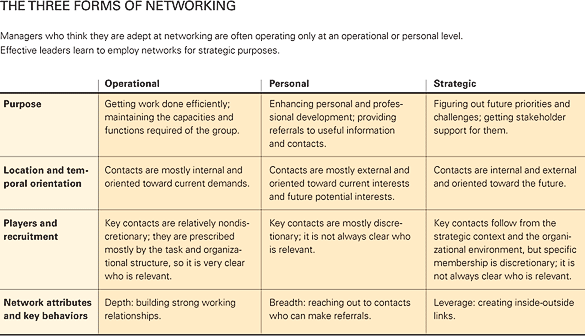
There is also another way of defining the types of networking based upon who the members of a network are:
-
Personal: Contacts who contribute to the search for information, support or references. In other words, they are friends or acquaintances who facilitate contact with other professionals in your sector.
-
Strategic: These are contact networks related to your sector. So they can enhance business opportunities, also providing ideas and criteria of interest for your personal and commercial growth.
-
Operational: Network of partners, suppliers and clients. These can contract your services as a company, allowing the relevant business management to grow. To establish such networks you need the visibility of personal networks and the experience of strategic networks.
Benefits from networking
Some of the main benefits from networking are:
-
Knowledge exchange and different perspectives. It is great to share ideas, interests, experiences, best practices, etc.
-
New opportunities for your social enterprise.
-
Greater visibility for you as a (social) entrepreneur and for your enterprise.
-
It will help you increase your self-esteem and confidence as a professional, but also in a personal way. Plus, it enhances your communication skills and keeps pushing you to talk with people you haven’t met before, and present them your idea/enterprise.
-
Foster connections. It helps to match your social enterprise with partners you may be interested in.
-
Learning about new developments and trends in your market.
Networking has several advantages: networking events and meet-ups can also be an excellent way to impress potential investors or business partners, and they will make you feel more inspired and motivated afterwards.
Where and how to network
As previously stated, one of the most common ways to build up a network used to be to attend events. Due to the COVID restrictions, face-to-face meet-ups have become more difficult to organize for a time, and online networking rocketed.
Regardless, networking events aim to bring together a wide range of highly-skilled and talented professional and/or (potential) entrepreneurs, from different backgrounds and sectors, focusing on establishing links and synergies. In an environment where they can share, create and develop ideas, these events are also a good moment to get in touch with owners and managers of existing and well-established businesses or social enterprises, to see if there are possibilities of working together. This sort of physical events can:
-
Provide you with perspectives and viewpoints from others on your industry or business serve as the first steps toward establishing channels of cooperation with others to inspire and motivate you;
-
People will start to recognize you if you attend business and social events on a regular basis. This can help you establish a reputation as a knowledgeable, dependable, and supportive entrepreneur, which will be remembered when the time comes to launch your business or social enterprise;
-
Create a sense of community for yourself with others, as well as for others with yourself. Your business’s or social enterprise’s sustainability, viability, and growth are dependent not only on having enough customers, clients, or service users, but also on your ability to connect with others and learn from them. These connections, especially if you are a sole proprietor, will be critical to the success of your business.
Social Enterprises related networks or business networks exist at local, regional, national and even international level, whether their members are connected by geographical liaisons, common objectives, theme, etc. A good starting point to find out the most helpful networks for you is to search on Google for (social) entrepreneur or (social) enterprise networks in your area, and then consider which ones are the most suitables.
In SAGA , local networking plays an important role and is extremely beneficial, if you are starting a social enterprise in a rural or less populated area and it will enable you to find collaborators, suppliers, investors, or customers and obtain support from the local community.