Curriculum
MODULE 3 - Functional Competencies
Unit 1 - Be prepared be organized! Organizational skills
0/8

Unit 2 - Networking & Partnering
0/9
Unit 3 - Managing relationships with providers
0/8
Unit 4 - (Self-)management for Social Entrepreneurs
0/8
Unit 5 - Social impact measurement & assessment
0/8
Unit 6 - Managing time & resources
0/8
Lesson
What is social impact measurement?
According to the International Association of Impact Assessment it is “the process of analysing, monitoring and managing the intended and unintended social consequences, both positive and negative, of planned interventions (policies, programs, plans, projects) and any social change processes invoked by those interventions. Its primary purpose is to bring about a more sustainable and equitable biophysical and human environment.
In other words, it is the change that your social enterprises generates in the ecosystem it operates in, being it social, environmental or cultural change. A social enterprise is the same as any other enterprise with regards to economic viability and financial sustainability, but the difference lies in the fact that a social enterprises in intrinsically have the generation of the aforementioned change or impact at the core of their “raison d´etre”. And this adds on another dimension, a social enterprise needs to have a positive impact on social, environmental or cultural level. In this unit we understand that the term “social impact” means any positive impact on society or the people in it and thus both the environmental and cultural aspects are considered to be covered by the term. Only in those cases where a distinction is needed this will be made.
Why is it important
The demand for (social) impact measurement and assessment has been increasing from the side of different types of stakeholders, not only social enterprises. Examples are:
- the political and institutional bodies to evaluate the expenditure of the implemented social programmes,
- the corporations that want to prove that their grant and subsidy to non-profit organization can be considered as a concrete investment and not only as mere donations,
- the foundations that have to select and evaluate the grants they allocate or the activities they fund and/or support,
- the impact investors[1] that must measure the social return on investments,
- the third sector that is liable to account for the impact to donors and beneficiaries.
Measuring impact in a proper way is important for all types of enterprises, as it allows to see whether results are obtained and objectives are achieved. And most importantly whether or not this can be directly correlated to the products or services offered by the enterprise.
There are 5 key terms which you should bear in mind:
- Inputs: what resources are used in the delivery of the product, service or activity.
- Activity: what is being done with those resources by the social enterprise.
- Output: how your activity touches the intended beneficiaries/clients.
- Outcome: the change arising.
- Impact: the extent to which that change arises from the delivery of the product, service or activity.
In evaluating impact based on outcomes, three more adjustments are taken into account:
- Deadweight: what changes would have happened anyway, regardless of the delivery of the product, service or activity.
- Alternative attribution: deducting the effect achieved by the contribution and activity of others
- Drop-off: allowing for the decreasing effect of the delivery of the product, service or activity over time.
Most social enterprises consider themselves catalysts for creating social impact. However, many find it difficult to define what the specific impact is and cannot demonstrate evidence of their impact. Due to this some social enterprises find themselves with business and financial constraints, and cannot drill into additional funding as often funders and investors demand evidence. They end up not thinking about their “social impact” and focus merely on survival due to a lack of resources.
How to measure social impact
Before we dive into the different methods to measure (social) impact, you need to be aware that any kind of measure needs proof or evidence. In social impact measurement there are 2 types:
- Quantitative: using numerical data (performance measures, indicators, etc.) to measure whether things are getting better
- Qualitative: using information drawn from interviews, conversations, dialogues etc. with staff, clients, partners, supporters and/or beneficiaries. A specific type of qualitative evidence is the one denominated “anecdotal”, which gears around stories or anecdotes about specific clients or beneficiaries and how they have benefited from a product, service or activity.
So what are the most commonly used social impact assessment or measurement methods? There are many, and we made a selection of a few. We know the list is not exhaustive and if the ones presented below do not convince you, you can search for other methods.
The advantage of using one of the existing frameworks and not develop your own is that you save time but also many of them provide guidance on how to actually do the measurement. Our 5 picks are:
- Sustainable Development Goals (SDG).
- Social Return on Investment (SROI).
- European Commission´s Expert Group on Social Entrepreneurship (GECES Standard).
- Global Reporting Initiative (GRI) standards.
- Triple Bottom Line
Social Development Goals Standards
The Standards are organized around four interconnected themes:
- Strategy: Embedding sustainability and contributing positively to the SDGs in purpose and strategy is important because it drives attention, focus and resources to what matters most and where your enterprise can have the most significant impact on important outcomes – including by reducing negative ones.
- Management approach: Integrating responsible business practices and impact management into decision making helps you generate options and make more informed choices between options to optimize their contribution towards sustainable development and the SDGs.
- Transparency: Being transparent is an important element of being accountable to Stakeholders – all interested parties including those affected or potentially affected in future by the your decisions and activities. It also helps Stakeholders make more informed decisions, for instance about whether they want to work with or for the your enterprise, to invest in it or lend to it, or buy or use your products and services.
- Governance is an essential element of embedding responsible business and impact management practices into organizational decision-making. Your informal and formal governance mechanisms define expectations of behaviour, how decisions are made and how the enterprise holds itself and others accountable for their decisions and actions in accordance with its values, principles, and policies.
In order to select the appropriate indicators for the impact assessment, your company should first choose a combination of indicators that offer a balanced and adequate reflection of the company’s performance and impacts in a given area. This includes considering different types of indicators, expressing inputs, activities, outputs, outcomes and impacts and ensuring a balance between lagging indicators (those that measure outcomes and impacts) and leading indicators (those that predict the outcomes and impacts).
The next action is to identify and collect data for each of the selected business indicators. It is not always possible to collect data directly, because of impacts occurring further up or down the value chain and also the complexity of the value chain. The cost and complexity of measuring must be proportional to the value that measuring helps to create.
Using existing business processes for data collection, for example extracting the required data from purchasing or sales systems, will be more efficient than developing new processes. If the required data is not available through existing systems, other general methods of collecting and aggregating data include field visits, questionnaires, focus groups, interviews and so on.
The full guide on the SDG impact standards can be downloaded here, and includes references to indicators on the 4 areas mentioned above. The guide can be downloaded here: https://sdgimpact.undp.org/assets/SDG-Impact-Standards-for-Enterprises-Version1-0-July-2021.pdf
If you need more support in defining the indicators, the SDG Compass (
www.sdgcompass.org) has developed an inventory of business indicators mapped against the 17 SDGs and their targets. The inventory contains existing business indicators from widely-recognized sources/standards, so you can select the most relevant ones for your enterprise.
Social Return on Investment
SROI is not only a tool to calculate social impact but is also provide a framework to make you think about the social value created by your enterprise. The process to calculate the SROI is just as important, or even more important, than its actual final value. The process (in terms of information, actors, discussions, data, etc.) limits subjectivity and arbitrariness and helps to upfront the complexity of the assessment. Don’t forget, you have to collect information, data and feedback from all the stakeholders you have considered.
SROI can have an evaluative nature, i.e. you measure ex-post the social value of the results you have obtained, or it can have a forecasting nature, i.e. you estimate ex-ante the social value of the expected results.
The steps for building your SROI are:
- Define the scope: define the reason why you want to calculate the SROI; define the target audience; define the objectives and business activities to be considered, identify the resources available (work, information, time) and also the the period of time that you want to consider (years).
- Identify and order stakeholders: ask yourself the following questions: Who receives a direct benefit?; Who contributes with the work?; Who brings capital?; Who suffers damage (societal, environmental, etc.)
- Define the Input-Output-Outcome for each stakeholder considered:
- INPUT: identify all the investments, resources and production factors used to carry out the activities (time, financial resources, fixed costs, volunteers, debts, consultancy, etc.).The value of all inputs must be monetized.
- OUTPUT: convert all the tangible results of the activities carried out (product, service, etc.) into numerical indicators (number of courses, number of products, number of young trained, etc ..)
- OUTCOME: are the benefits (changes) for each stakeholder deriving from the business activity (number of young people who find a job)?
- Define the outcome indicators and monetary evaluation:
- INDICATORS – Outcomes must be expressed through measurable indicators
- DATA – They are used to measure outcome indicators. Collect existing data or define the collection of new data for future evaluations
- MONETARY VALUES – The indicators are monetized by different techniques. Assign a monetary value to indicators that do not have a market price resulting from the match between supply and demand
Here are some techniques that can help you monetize the indicators:
Cost-price based: There are comparable costs or market prices
- Incurred Losses Method (ILM): costs of negative situations: accident, unemployment (unemployment benefit, hospitalization, etc.).
- Hedonic Price Method (HPM): difference in value determined by context factors (security in a neighbourhood by value of houses).
- Cost Prevention Method (CPM): costs of prevention to avoid the worst costs.
- Traveling Costs Method (TCM): willingness to pay the trip to receive a product/service.
Value-price based: There are no indications of cost or price
Contingent Evaluation: willingness to pay for goods and services that are priceless (leisure, landscape, need, well-being).
Here is an example of a guide that make SROI accessible to a range of audiences, including those with limited resources: https://commdev.org/pdf/publications/Measuring-Value-A-Guide-to-Social-Return-on-Investment.pdf
Standard GECES and the Theory of Change
The standard was officially adopted by EC in 2014 with the aim of developing a rigorous and systematic methodology to measure the socio-economic benefits created by social enterprises; evidencing how the money invested in social enterprises yields high savings and income; and agreeing upon a European methodology which could be applied across the European social economy. It is a pan-European standard on impact measurement, which aims to enable social ventures to maximise their full potential, being based on a widely recognised flow, known as the Impact Value Chain (also known as the ‘Theory of Change’ or ‘Logic Model’)
GECES divides the measurement into four key elements:
- PROCESS – a common process of measurement designed to give the account of the intervention, its outcomes and how it achieves them, also known as the five stages for social enterprises to measure their social impact.
- DISCLOSURE STANDARDS – which are certain universal and mandatory characteristics that define measurement disclosure (reporting) that is of acceptable quality.
- FRAMEWORK: a matrix of the outcomes.
- INDICATORS: the method used to assume a value or a measure to the results and to the impact.
The standard defines 5 steps for social enterprises to implement impact measurement:
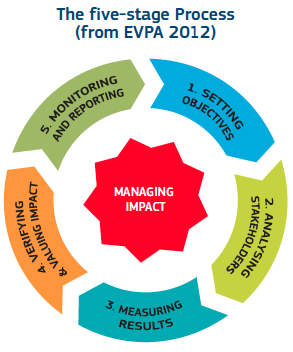
- Identify objectives of the various parties in seeking measurement and of the service being measured.
- Identify stakeholders: who gains and who gives what and how?
- Set relevant measurement: the social enterprise plans its intervention, and how the activity achieves the outcomes and impacts most needed by its beneficiaries and stakeholders. This link from activity to impact is the social enterprise’s theory of change. It will decide this, and establish measurement most appropriate to explaining the theory of change and the achieved impacts, and will then agree it with major stakeholders.
- Measure, validate and value: assessing whether the targeted outcomes are actually achieved in practice, whether they are apparent to the stakeholder intended to benefit, and whether they are valuable to that stakeholder.
- Report, learn and improve: as the services are delivered and the measurements of their effectiveness emerge, so these results are reported regularly and meaningfully to internal and external audiences
Each of the five stages of the process outlined above is relevant to and involves stakeholders at all levels ranging from investors to service-users. In the self-reflective questions we have included a table which guides you to the questions to be answered.
The GECES standard is based on the Theory of Change that refers to the means (or causal chain) by which activities achieve outcomes, and use resources (inputs) in doing that, taking into account variables in the service delivery and the freedom of service-users to choose. It forms both a plan as to how the outcome is to be achieved, and an explanation of how it has occurred (explained after the event).
The full guide can be downloaded in various languages here: https://op.europa.eu/en/publication-detail/-/publication/0c0b5d38-4ac8-43d1-a7af-32f7b6fcf1cc
Global Reporting Initiative
The GRI Standards enable any organization – large or small, private or public – to understand and report on their impacts on the economy, environment and people. They have been designed as modules, to provide an overview of how the organisation manages and achieves its (social) impacts.
The approach has 3 modules
- Universal standards, which include human rights and environmental due diligence. GR1 Foundation: lists the requirements that an organization must comply with to
report in accordance with the GRI Standards, and also how to provide good quality reports. GR2: General disclosures provides details on the organisation (profile, scale, etc) and provides context for understanding the impact of the organization. GR3 Material Topics explains how you can determine the topics most relevant for the impacts. - Sector standards: consists of an initial section that gives an overview of the sector’s characteristics, including the activities and business relationships that can underpin its impacts. The main section of the Standard then lists the likely material topics for the sector.
- Topic standards: list disclosures relevant to a particular topic. Examples are Standards on waste, occupational health and safety, and tax.
To read more: https://www.globalreporting.org/media/wtaf14tw/a-short-introduction-to-the-gri-standards.pdf.
You can download the standards here, they are available in different languages. https://www.globalreporting.org/standards/download-the-standards/
Triple bottom line
The Triple Bottom Line is an accounting framework that incorporates three dimensions of performance: social, environmental and financial. This differs from traditional reporting frameworks as it includes ecological (or environmental) and social measures that can be difficult to assign appropriate means of measurement.
It integrates economic, environmental and social value creation as core to an organisation’s business model. Three categories make up the triple bottom line;
- People: these are ALL stakeholders including employees, communities (within which an organization operates), individuals (from the supply chain), future generations and customers. It measures social variables dealing with community equity, social resources, health, well-being and quality of life.
- Planet: is about consequences businesses have on the environment, community, and the economy and the importance of global issues, such as climate change and social justice. It measures environmental variables related to natural resources, water and air quality, energy conservation and land use.
- Profit/Prosperity: Reflects the systemic nature of the approach by adding on economic variables with the bottom line and cash flow. Triple bottom line profits are measured in a much greater way than Euros added to the bottom line. Profit in this framework can also be measured as profit can also be evaluated in terms of impact on economic growth, business innovation, and business decision making.
The downside of the framework is that there is no specific method for measuring its impact. However there are several tools you can use to measure each of the 3 Ps mentioned above.
For the “people” the Global Reporting Initiative, provides reference to the social impact of your business, which can be used to assess the impact on this P.
In the same manner the GRI indicators can be used also for the Planet, and in particular with regards to the environmental impact. The most used indicators here are: Renewable energy use and energy consumption (direct and indirect); Amount of material that is recycled; Amount of water withdrawn from local water sources; or Total NOx, SOx, and GHG emissions
Apart from the more traditional profit and business related indicators, there are additional questions relevant to measure the economic sustainability of the enterprise. Examples of such questions are:
- Does your business help local suppliers stay in business and innovate? Or do your activities put the local economy at risk?
- Do you pay employees enough to stimulate economic growth and spending? Or does your compensation policy shrink local economy?
- Do you choose materials that are economically a good investment? Or do you buy cheaper products that create issues in other areas? For example, do you buy chemical products that are low emission, or cheaper high-VOC products that put your environmental compliance at risk?
The framework is the ideal tool for evaluating company decisions, as by contrasting the decisions not only form the economic (Profit) perspective. Asking yourself what are the consequences of the decision you are taking for your employees, community or suppliers or for the environment or social justice, and have these weigh into the final decision you take, will allow you to be (or become) a sustainable social enterprise.
[1] An impact investor seeks to generate both financial and sustainable value. It consists of a set of investment approaches that integrate environmental, social and governance and ethical issues into financial analysis and decision-making.