Curriculum
MODULE 4 - Social Competencies
Unit 1 - Co-creation | co-design | co-working
0/8

Unit 2 - Leadership in social enterprises
0/8
Unit 3 - Self-confidence
0/8
Unit 4 - Achieve Change as a Social Entrepreneur
0/8
Lesson

There is no single business which is able to operate completely independently without the involvement of external stakeholders such as various partners, providers, public bodies, etc. Cooperation on different occasions, involving a number of stakeholders is crucial for the proper functioning not only of a social enterprise, but for any existing business due to the fact that even entities which are “at the top of the food chain” can’t rely on their luck or success for a long period of time, without reaching a point in which they simply run out of innovative ideas. Then, the problem that occurs is how to successfully manage to solve problems and create new products and services in order to meet customer’s needs. Here comes the solution called: co-creation, co-design and co-working.
Co-creation
Co-creation is a method used to engage a wide range of stakeholders that would normally never be involved in your process of work, including customers, who are normally the people who matter most. The persons, or entities, with which you can co-create can be various actors from the ecosystem, each bringing added value to the innovation process, ensuring that the final products or services provided closely align to the needs of the final users or give a solution to their problems as well.
But what is the official definition of “co-creation”? There is no universal one, but said with the simplest words, co-creation represents a situation, in which businesses involve external actors (suppliers, partners, customers, various public bodies and policy makers, etc.) in the so-called ideation and development processes. The whole “co-creation” idea is not something absolutely new, but in fact, the term itself was popularized by a “Harvard Business Review” article, published in the 2000s, where the authors put the focus in the relationship between a business and the customers. In particular, co-creation is actually really useful, since there are a lot of entities that keep their new products or services strictly internal, which limits the opportunity to see the things from different angle and receive real feedback from representatives of the target group you are creating for. Indeed, co-creation helps businesses to cooperate and receive new, innovative and fresh ideas, stepping out of their comfort zone, and making it easier to receive answers of questions that they do not have answers to internally. The main objective of the whole co-creation process is to see existing problems from a new and fresh perspective and come up with better products and services based on the solutions identified.
How the co-creation process actually works in real life?
There are various ways in which a business can involve external actors (suppliers, partners, customers, various public bodies and policy makers, etc.) and engage in a co-creation process in order to make these actors part of their ideation and development processes. In fact, it is very likely that not many of you have thought about many traditional research and development techniques, such as for example conduction of surveys and focus groups among the end users of a specific business, striving to learn more about their preferences and the things that they would change about the way in which this business works at the moment. These “old-fashioned” types of engagement with the customers are typical examples of a co-creation process, as it involves a business and its customers. Of course, with the recent developments in the IT sphere, there are numerous other ways in which different stakeholders can take part in the co-creation process, i.e., through various modern software, internet forums, social media, etc. that allow the co-creating process to occur at every stage of the development process – from the assessment of the initial idea, through the review of the created product or services, to its realization on the market. Something to be noted down and remembered is the fact that when a customers or a supplier involved in the co-creation process have the feeling that their word is being heard, they naturally become more engaged in the success of the business.
What are the benefits of an effective co-creation process?
The effectiveness of the co-creation process can be measured by the level of satisfaction of the participating actors. A well-structured co-creation process brings added value in all processes of the management of a business, company, social enterprise, etc. In the next paragraphs, more about the different ways in which co-creation process generates value are further explained:
-
Design and development of better products and services, based on customer’s needs: Probably the most valuable asset gaining through engaging in a co-creation process is to create something new. There does not exist any business which does not to be unique and create products and services that their competitors are not capable of. Unfortunately, this might be considered impossible due to the involvement of the same people with the same way of thinking each time when brainstorming new development ideas. Doing it this way, you will be to come up with new ideas which are everything, but not new. Co-creation is making it possible to research new viewpoints and even it will not be necessary to predict what are the preferences of your end users, as thanks to the co-creation process, they will be able to do it themselves, resulting in new products and services that 100% reflect the way that the end user think.
-
Improving financial performance: The co-creation process can both save you financial resources and help you increase your revenue. But how exactly? It can save big sums from the costs usually spent for research and marketing, for example. Through the co-creation process you will be able to have direct access to your target groups by working closely with them and obtaining their feedback on a regular basis without the need to additionally invest in these types of services. And being able to hear the opinions of external actors who are your potential clients will give you the opportunity to design, or refine a product or service in order to meet the needs of as many end users as possible, increasing sales revenue.
-
Brainstorming innovative and unexpected ideas: The staff of each entity consists of specialists and experts in the field in which they work and specialize. Of course, there is absolutely nothing wrong with this, but when it comes to brainstorming new and innovative ideas, there is a big chance for you team to fail in this task, as they will continue to think the way in which they do their job. By default, your goal will be to always come up with exciting products and services and the co-creation process will assist you with that by adding new actors on the work map. It is not necessary for these actors to consist of people who you will be willing to hire someday in the future, but their vision and way of thinking can bring some valuable ideas, even from individuals who do not have the necessary expertise at all. Involving external stakeholder through the co-creation process will allow you to approach your way of doing things from a whole new perspective.
-
Establishing partnerships with a wide range of stakeholders: It is a common thing, especially for the bigger companies, to have miscommunication between the different departments – this is the so-called “silo effect”. This effect can also be used in the context of the work between different entities as well. For example, a social enterprise in the gastronomy, culinary heritage and food sector does not think about the latest trends existing in a software company. The social enterprise will always hire people who have a specific set of knowledge and skills in the field of gastronomy, food, etc. Co-creation empowers the entity to involve brand new skills by including external people in the process.

Co-design
While the term “co-creation” refers to a process of cooperation between various stakeholders (suppliers, partners, customers, various public bodies and policy makers, etc.) mostly by exchanging and sharing ideas and experiences, the concept of “co-design” (also called participatory design) presents the opportunity to create with external actors. The main differences between the two processes are that the co-creation is used mainly in the ideation phase of a product or service, when new ideas are being generated, while co-design has a lot to do with the actual design of a product or service.
How the co-design process actually works in real life?
As already explained, the complex problems existing nowadays that challenge the world we live in are too broad for them to be tackled by one single discipline only. This is the reason, due to which so many actors are involved in the process of co-designing – suppliers, partners, customers, various public bodies and policy makers, etc. The co-design process allows them to face the complex problems and develop an “action plan” needed to improve their current experience and co-create a new and innovative solutions of these problems.
The co-design process requires the involvement of many actors, which means that usually, specific roles and responsibilities are being defined according to the context. For example, imagine working with a food provider in order to improve the way of living of homeless people. Applying a co-design approach to this challenge, needs to bring the different people and organizations together to get a full picture of the opportunity landscape and to co-create new solutions. For example, this group of actors might include: homeless people (as they are the initial target group), professionals who work with homeless people, policy makers, government structures, suppliers, etc. Ultimately, the scope or scale of the project will determine how many stakeholders are represented as well as where in the process they will contribute.
Usually, the key steps of a co-design process include the following:
- Engage – Try to learn from each other and set the specific challenge to be solved;
- Understand – Try to focus on the users’ needs and gather key insights for each stakeholder;
- Ideate – Start exploiting the co-create design concepts and make prototypes;
- Validate – Check the validity of the co-created solution testing it with the end users;
- Re-think and improve the prototype based on the feedback obtained during the previous stage.
What are the benefits of an effective co-design process?
To approach a challenge from a co-design mindset helps to ensure a great process and outcomes that make sense to people. In the next paragraphs, the different ways in which co-design process generates value are further explained:
-
Co-design enables everyone involved to be an active agent of change. The design of future solutions is not limited to specigic groups of people, but everyone including users, client or employees can take part in it, so their needs and experiences have become more relevant;
-
Co-design helps to better connect all relevant parties and it boosts collaboration across disciplines;
-
Co-design process fosters the motivation of everyone involved and also increases openness to innovation and change;
-
Co-design leads to more inclusive and credible solutions;
-
Co-design has a strong focus on relization and implementation enabling more targeted and differentiated products or services.
Co-working
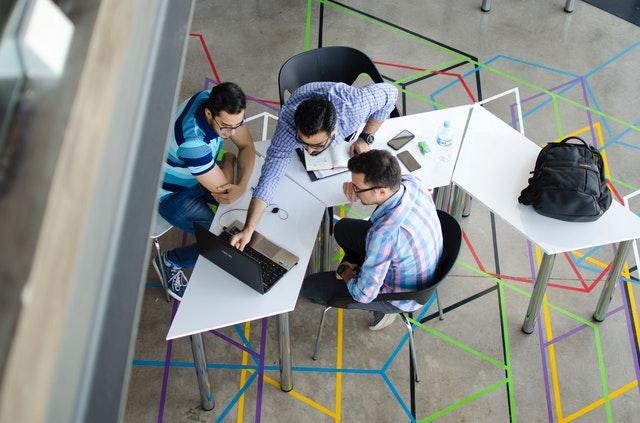
With simple words, co-working is when people from different backgrounds gather in neutral space with the aim to work independently in different projects, or in groups on the same projects. Co-working environment is different than the traditional office workspace, because the people in the co-working environment are usually not working for the same organization. A typical co-working space will offer the same amenities as in a traditional office, or even more. A major difference between the office and the co-working environment is the flexibility offered by the co-working space.
What are the benefits of the co-working?
There are various reasons due to which people prefer to work in a co-working space rather than at home or in the office. In the next paragraphs, more about the different ways in which co-working generates value are further explained:
- Co-working increases productivity;
- Co-working provides more networking opportunities;
- Co-working boosts creativity and innovation processes;
- Co-working provides opportunities for collaboration;
- Co-working is considered as cost-efficient;
- Co-working ensures greater flexibility.