Curriculum
MODULE 4 - Social Competencies
Unit 1 - Co-creation | co-design | co-working
0/8

Unit 2 - Leadership in social enterprises
0/8
Unit 3 - Self-confidence
0/8
Unit 4 - Achieve Change as a Social Entrepreneur
0/8
Lesson
A common mistake is to confuse similar concepts which are used by many people in ordinary conversations. Self-confidence is an excellent example for this, very often we use it incorrectly, because it’s meaning is mixed with self-efficacy and self-esteem. Below we will see what is the difference between them while trying to distinguish them:
Self-efficacy: refers to your belief in your ability to accomplish a specific task. If you don’t believe you will actually succeed in a project, like cooking a fancy dinner for your loved ones for example, then there is a high chance that you will put less effort into the task and won’t succeed in it just because you thought you are not good at it. To summarize, people with low self-efficacy often put less effort into a task if they don’t believe they’ll succeed at it, increasing the likelihood of failure.
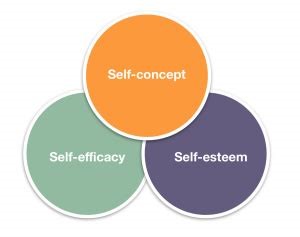
Self-confidence: compared to self-efficacy, self-confidence is more of a general view of how likely you are to accomplish a goal, mostly based on your past experience. When you practice basketball or cooking, to stick with the previous example, you are constantly increasing your ability to do the said thing. This can also apply to how likely you believe you are to be accepted in a social group. If you have been made fun of before in a certain group, you might be less inclusive and confident next time with other groups. Self-confidence and self-efficacy are both rooted in experience, but self-confidence reflects a broader view of yourself, rather than your confidence in specific tasks.
Self-esteem: The term most often confused with self-confidence is the one perhaps least similar to it. Self-esteem refers to a belief in your overall worth. Broad statements like “I am a good person” or “I am a good entrepreneur” fall into this category because they are built up from multiple elements. Improvements in your self-efficacy and self-confidence can contribute to your self-esteem, which is a broader concept than the previous two.
These concepts are often over-lapping and even psychologists have problems to separate them.
As an attempt for clarification: you can have enough confidence to believe that you’re capable of learning how to make a new dish, for example, while simultaneously lacking the self-efficacy to believe that you’ll be any good when you first start. Likewise, you can have zero confidence in your ability to cook while still believing you’re a good person/entrepreneur.
In the next paragraphs we are going to analyse self-confidence to see why we need it and how can we improve it. As a definition we can say self-confidence is an attitude about your skills and abilities, it means you trust yourself and have a sense of control in your life.
But why is self-confidence important if someone wants to establish and run a social enterprise?

Most importantly it might be because it is hard, if not impossible to run a business if you are in constant fear of making mistakes and afraid of not being good enough. The presented case study showed that positive experiences and feedbacks can empower someone to take the risk and against all odds (bad economic situation, constantly changing laws and regulation) to start a business. Such a decision takes a lot of courage. As we already described above, self-confidence is based on someone’s perception, how the individual sees itself. His/her environment, the people he/she is having around also has an important role to play in someone’s self-confidence because we are always influencing each other, sometimes we even do it unintentionally. Fortunately, your self-confidence doesn’t come from a single source. We can name at least three main factors which are having impact on self-confidence:
- What you were born with, like genes, which impact the neurochemical balance in your brain e.g.
- Social pressure, your natural/social environment.
- The part you have control over, the choices you make, the risks you take.
We can’t hermetically separate these three factors, since they overlap, external and internal factors are mixed. Your current choices, decisions (3) can be products of failures from your past or they are due to hereditary factors (1) so the part you have control over (3) is a composition of other factors.
Studies found that high self-confidence might lead to more chances to improve. It’s a classic trial and error situation where the more you are trying, the more you will learn, if failures won’t wear you down.
Self-confidence is not a measure of your actual skills, of course, if you are good at something then your confidence can grow too, but these two things don’t always correlate. Like in the funny fail videos on the internet, in which people are more confident in themselves than their actual knowledge/practice would justify it. So, self-confidence doesn’t directly measure your actual skills, but contributes to the process of becoming good at something. In other words, confidence helps you take risks and by that making tangible improvements in your life. Sometimes there is only a line between healthy self-confidence and total recklessness, and that line can be very slim. What you should pay attention to is, that even though self-confidence is fragile and many factors in your life can have an effect on it, you shouldn’t give up trying. Paradoxically experience is the same thing which can boost your self-confidence and also cause damages to it.
Hitchiker’s guide to a healthy self-confidence:
Self-doubt can suffocate good ideas in you, or as it can be found in the Oxford Handbook of Positive Psychology: “If the person lacks confidence, again there will be no action. That’s why a lack of confidence is sometimes referred to as ‘crippling doubt.’ Doubt can impair effort before the action begins or while it is ongoing.”
Therefore, what should you do to improve your self-confidence? The tips we share below are from Charlie Houpert, author, and owner of a YouTube channel which has almost 5 million subscribers. On his channel he is explaining concepts, related to charisma, self-confidence, and teaches you tricks, to help you in the most common social situations.
1. Be honest with yourself!

It is an everyday way to exercise self-confidence. Why being honest with yourself is important? Because as a social entrepreneur you have to ask yourself uncomfortable questions from time to time, like “Why am I running a social enterprise? Am I doing it because of profit, or good reputation? Is my intention still sincere and selfless?” Answering to self-reflecting questions can help you accept who you really are and what you want to achieve with your business. By that you can stay authentic in the eyes of yours and others, seeing yourself clearly can have a huge positive effect on your self-esteem. The point is to stop hiding parts of yourself form other people and from you too, when you start to accept yourself with your flaws self-confidence will come along.
2. Work out!
Exercise is not only for those who want to stay healthy or lose weight, it can be a huge boost to your self-confidence. Exercise can improve your mood and it can help improve your confidence if you stick with it for a while. Working out regularly requires a commitment, and keeping that commitment is an accomplishment. Not only does sticking to a new healthy habit make you feel more confident, but you can also spot physical improvements to your body and health over the long term.
3. Try things that make you uncomfortable
We are not going to say anything new, when we state: we are all prisoners of our comfort zone and stepping out of it is uncomfortable. Confidence is ultimately about being comfortable in a wide variety of situations that would make most people feel uncomfortable. If you stretch your comfort zone every day, very quickly you’ll have a large comfort zone and be able to feel more comfortable even in areas where you felt uncomfortable before. The key here is the same as at the work out, important that you regularly expand your comfort zone rather than occasionally throwing yourself into the deep end. You don’t have to implement big changes at first, especially if you are rather a shy person. As for start you can try to start conversation with someone new. Slowly build up the courage to do things which might have seemed extreme before.
4. Defeat/Handle your “impostor syndrome”
Impostor syndrome is the situation where you convince yourself that your accomplishments don’t really count and that you’re going to be found out as a fraud. This doubt can creep in because it’s easier to remember faults but more difficult to remember successes. Make a habit of periodically writing down or reflecting on times you’ve done things well. It’s easier to be confident in your abilities when you remember them.
These are all perfect ways to start and work on your self-confidence, but maybe the most important is to be patient with yourself. You might ask yourself, how can I be sure, that I won’t become arrogant during the whole self-confidence developing process? But as it is well known, arrogance is more the result of insecurity than high self-confidence. Confidence is self-satisfaction, while arrogance requires external validation to feel good. You may know some people around you who are bragging to solicit the recognition of others. Someone with true self-confidence is capable of being assertive and standing up for themselves, but they’re unlikely to adopt a tone that others perceive as arrogant. Oddly enough, the best defense against arrogance is developing true self-confidence.
The importance of self-confidence in social enterprises

Self-confidence is vital in almost every aspect of our lives, yet many people struggle to find it. Sadly, this can become a vicious cycle: people who lack self-confidence are less likely to achieve the success that could give them more confidence. In a social enterprise self-confidence is also important. You need self-confidence to start your business, to believe in your abilities. Confident people inspire confidence in others: their stakeholders, their co-workers, their customers, and their friends. You can’t sell your vision/product to others if you don’t believe in it either. Self-confidence has to be a constant element of the life of a social entrepreneur. The work and effort you invest in building a healthy self-confidence eventually pays off, and you can enjoy it’s benefits along the years. And gaining the confidence of others is one of the key ways to succeed. Without self-confidence the possible stakeholders, partners, customers won’t have faith/confidence in you, so they are going to do business with someone else, elsewhere. To sum up, your self-confidence can inspire others too and makes easier for you to convince others to work together in your social enterprise.