Curriculum
MODULE 2 - Defining your Social Business
Unit 1 – Business Model Canvas for social enterprises
0/8

Unit 2 - Finance & fundraising
0/13
Unit 3 - Legislation
0/1
Unit 4 – Marketing for social enterprises in the field of gastronomy
0/8
Lesson
The basis of any successful business is careful business planning, the end product of which is a business concept. This applies to social enterprises as well: in addition to seeking to alleviate and solve a social problem, it is essential for the success of a social cooperative that it operates in a financially sustainable way like any other enterprise.
1. What is needed to start a social enterprise?
The elements listed below are just as important conditions for starting a social enterprise as they are for starting any other business.
An IDEA is needed that
- satisfies solvent demand (market),
- results in economically measurable, profitable activity,
- can be operated commercially sustainably and can gradually become independent of state resources.
A LEADER is needed who
- is able to plan the activity,
- is able to find partners (founding members, memberships, etc.) who can carry out the tasks related to the planned activity,
- can motivate those involved in the task.
Must have RESOURCES – – – MONEY, MONEY, MONEY – – – which
- provides liquidity until the first income of the social enterprise,
- creates the financial background for the operation – investments, fixed and varying operating costs, taxes, etc.
A COMMUNITY is needed that wants to collaborate, from people who
- recognize the potential of social enterprises,
- who are willing to work within a social enterprise for common goals.
A PROFESSIONAL SUPPORT BACKGROUND is needed
- in the phase of establishing and operating a social enterprise, as well as in building relationships and markets, cooperation, advocacy, marketing in the phase of effective economic growth and market access.
The Business Model Canvas helps you think over these issues in a structured way.
2. Business Model Canvas (BMC)
The Business Model Canvas was created by Swiss economists Alex Osterwalder and Yves Pigneur and is perhaps the most widely used method in the world of start-ups. The Canvas is somewhere between a concept sketched in a checkered notebook and a nearly 30-page business plan. It does not serve to replace any of the above-mentioned two, but is an intermediate step in development. It has content detail that is much more than an outlined idea, yet it is easy to review and is completed faster than a complete business plan.
The essence of the Canvas model is that the business vision of an enterprise should be presented concisely on a single page, a “canvas”. This is a template that helps you think through the most important elements of the planned activity, and it is precisely because of the concise wording and transparent structure that the errors and weaknesses of the design become easily noticeable.
If the business and other environmental factors have changed in a relevant way to the business, the Canvas can be flexibly adapted. This is an immense advantage in an ever-changing market environment.
3. The areas of the Canvas model
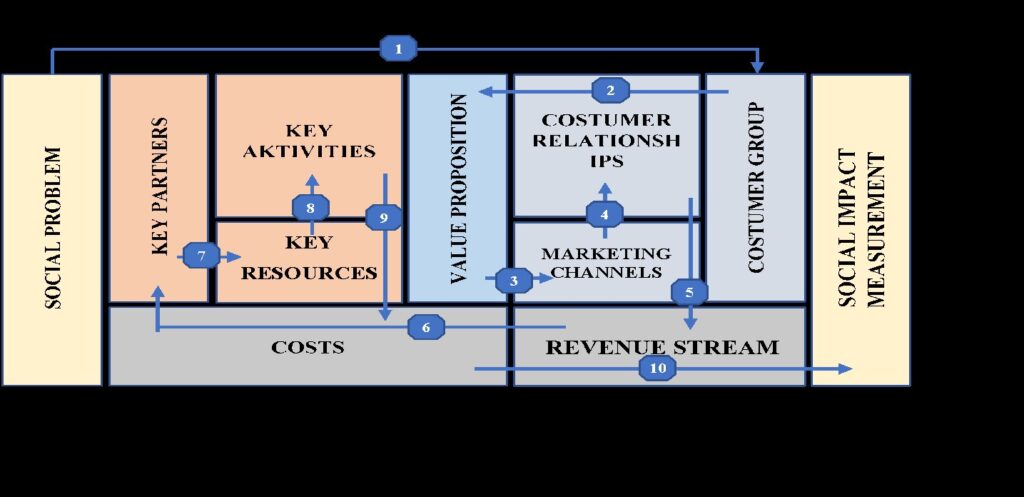
Given that the Canvas is public under a “creative commons license,” it has been further developed by many in many ways. In the Canvas model, it is proposed to outline the business model in 9 areas, while in the case of social enterprises 11 areas are proposed. The examined areas can be divided into four major categories.
Therefore, the creation of value – key resources, key processes and key partners – appears on one side of the value proposition, while on the other side the provision of value – customer groups, channels, customer relationships – and from the third direction the financial basis of the value – cost structure, revenues.
In the case of social enterprises, this is complemented by a fourth area, presenting the social problem and social impact.
4. How to get started using Canvas?
The easiest way to fill it out is to print the Canvas in a nice large size, sit around it and fill it with content by brainstorming. We can make the most of it by thinking about each element within the framework of an expert-led professional workshop. There are online versions as well, so whoever is more comfortable with filling it out electronically can do so.
Step by step
In the process of thinking, it is worth following the numbered order.
4.1. Social problem
In the case of a social enterprise, the first to be determined is what social problem we are responding to in connection with our business. Let us try to be as specific and concise as possible, not mentioning general issues but goals as specific as possible, while at the same time being ambitious.
Next, let us turn to our business ideas and formulate who our value proposition is for, to whom we offer our products and services.
4.2. Customer groups
Start the thinking process by getting to know the customer: determine who can be receptive to the product or service we provide. The first basic rule of marketing is known to all by now perhaps, namely that customers should be grouped, one cannot sell to every single person. If one wants to sell to everyone, they won’t sell to anyone! Form homogeneous groups of customers with similar characteristics, describe their characteristics, and also highlight how you create value for them. If you define more than one customer group, highlight who the most important customers are. When defining customers, our job is to identify the medium that is not too narrow, but not too broad, who may be receptive to what we offer. Further think through who might be the first to use and distribute the product, pay for the service.
4.3. Value proposition
It is the set of products and services that serve the customers’ needs. In this subsection, we rethink what the real value will be to the customer from our products and services. This sets us apart from our competitors. It can include anything – quality, customizability, design, brand, price, cost reduction, availability and usability. If not all, but we will need one or two of these for a successful business. How will we be better, more efficient, cheaper and more attractive than the products and services already available on the market? How does our offer fit into the world of the customer? How can we help our customer achieve their goal?
4.4. Sales channels
Once we know for whom and what we offer, we shall determine how – through what channel we can reach our consumers. To put it simply, let us collect the platforms where our consumer can buy our product. Therefore, it is immeasurably important to have as much information as possible about our customers. Where do they find information, where do they shop, what channels are available, etc.? Let us not derive from our own desires, but from the habits and behaviour of our customers. Get to the forums, platforms and places that they frequent, where they shop anyway, where we have a chance to present our product and service to them.
4.5. Customer relations
Different consumer segments may require different sales (or marketing) strategies. In this section, let us explain the contact with our customers in as much detail as possible. It can be automated or personal, personalized, self-service, but it can also be community-based or constructed together. Thinking about and analysing the specifics of the customer target group and sales channels can help. In general, the larger the number of customers, the more impersonal our relationships are, while with smaller numbers of sales, we can afford more personal advice and handling.
4.6. Sources of revenue
We can now think through the volume of sales we expect through each sales channel, and how much revenue we expect from it. Naturally, in order to do this, we need to price our product or service as we need to know how much revenue the sale of a unit means. At this section as well, many design flaws can be noticed. If our production capacities only provide small series production, we cannot plan to sell larger volumes. Due to the low level of mechanization, we may not be able to be competitive in terms of price, in which case we need to focus on our other competitive advantage and apply pricing that reflects the quality of the product. It is important to understand that price is an integral part of a product; if we want to convince consumers of its quality, we need to use appropriate pricing. Finally, in addition to the itemized listing of revenue sources, it is worth examining the relative proportions of each revenue channel. This is important because it helps us see the proportion of the weight of a source of income and, if the situation in which it is lost presents itself, what would the results be in relation to the profitability of the company.
4.7. Key partners
In this section we list the most important partners and suppliers. It is worth mentioning here those who are critical in terms of value creation. List here also the partners from whom we obtain key resources or outsource our key activities. It is worth thinking as carefully as possible about which partners will be crucial to our success. Their unreliability or poor quality of service can be a serious competitive disadvantage.
4.8. Key resources
As a critical resource, we look at the assets of the enterprise that possess the enterprise’s ability to provide a competitive advantage. By their nature, these resources can be physical, immaterial, and financial, so we include: people, capital, physical and intellectual products. The lower the level of entry into a given business, the more difficult it will be to secure our competitive advantage, thus the more aware we need to be about it. Rare, valuable, hard-to-copy, and well-embedded resources in an organization are a huge business benefit. What is sure is that we need to find a resource in some area that can secure our competitive advantage.
4.9. Key activities
Consumer value creation takes place through processes within the business. In this case, it is worth highlighting those activities that directly contribute to our competitive advantage and the creation of consumer value: so no frills, just the most important, without which customers feel that they did not receive anything. This is one of the most important factors that separate companies, whether there is an activity within the company that adds to the value of a product / service, or increases its uniqueness. If so, this can be called a competitive advantage. In this element, the activities that ensure this will play a key role in our business success.
4.10. Cost structures
We have now arrived at business efficiency planning. We now calculate and describe our costs incurred, within which it is worth distinguishing between fixed and variable costs. At this point, it will be revealed what and how much we will spend, and the pricing methodology will also become clear. Comparing planned costs with revenue sources, we can already see clearly whether our business vision will be sustainable and whether we will be able to sell at a volume that can ensure reaching the break-even point. If not, what changes are needed to achieve this? The volume of production needs to be increased, we have to sell at a higher price, but then our target group can change as well!
4.11. Social impact measurement
Finally, let us determine with what success indicators and other indicators we will be able to present our social impact, and that as a social enterprise we “do good – we represent an important cause”, and what analyses, methods and tools we will need to examine them. Let us make ourselves visible!
One of the biggest advantages of the model is that the order can be changed freely.
5. Canvas business model in practice – answering the questions in the box will help fill out the canvas.