Curriculum
MODULE 2 - Defining your Social Business
Unit 1 – Business Model Canvas for social enterprises
0/8
Unit 2 - Finance & fundraising
0/13
-
Unit 2 - Details
 Trial
Trial -
Case Study
Trial
-
Lesson - introduction
Trial
-
Lesson - Expenses: Types of Costs
Trial
-
Lesson - Break-even Analysis
Trial
-
Lesson - Profit and Loss Account
Trial
-
Lesson - Cashflow Forecast
Trial
-
Lesson - Finance and Stakeholders
Trial
-
Tips & Tricks
Trial
-
Important concepts/definitions
Trial
-
Self-reflective questions
Trial
-
You may also be interested in this/ Additional useful resources
Trial
-
References
Trial
Unit 3 - Legislation
0/1
Unit 4 – Marketing for social enterprises in the field of gastronomy
0/8
Lesson – Finance and Stakeholders
As a social enterprise, you will have access to a wider range of funding options ranging from investment funding to grant funding. Being over-reliant on any one source may be a high-risk strategy and might prevent you from growing. You will need, therefore, to think carefully about your funding route. At the same time, you ought to be accountable to your stakeholders such as funders, investors and other stakeholders’ requirements.
Here are several ways of raising finance:
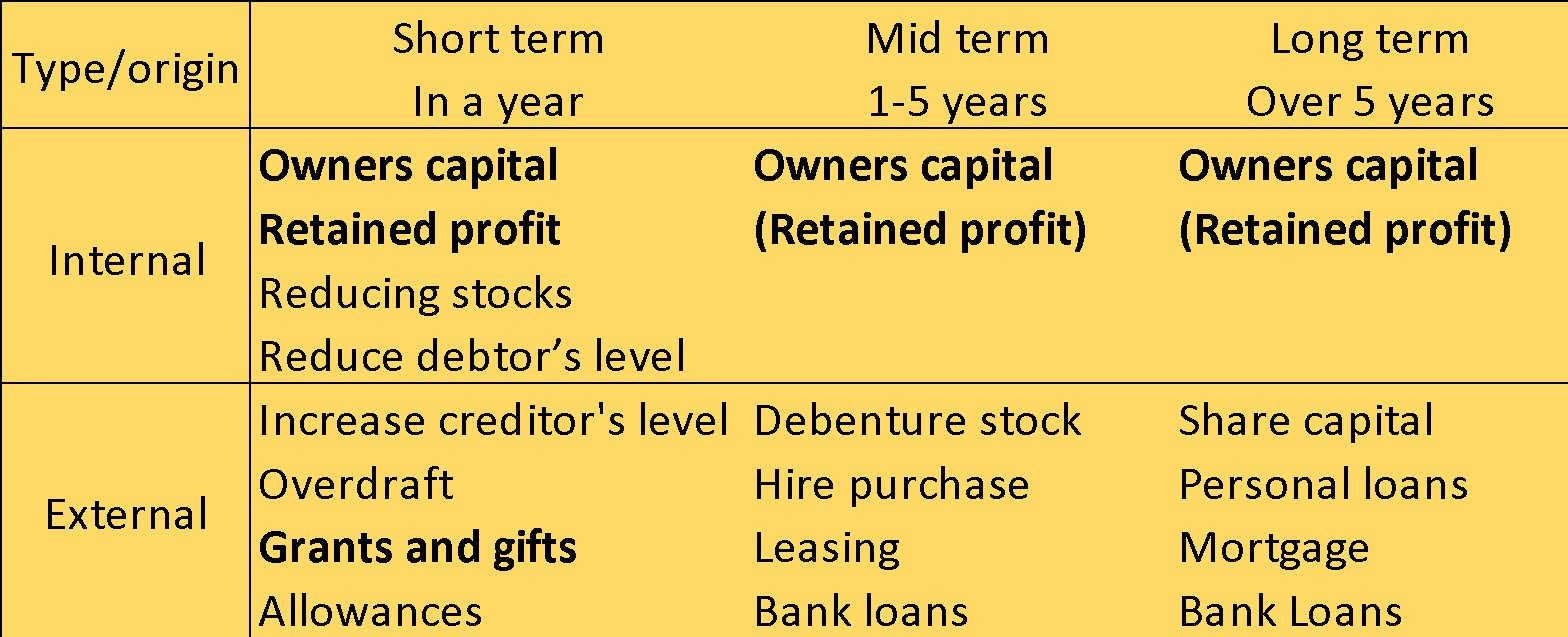
Distinguishment between internal and external sources comes in handy when measuring an enterprise’s exposure. Your request for bank loans, mortgages, personal loans, leasing services could be turned down based on exposure. Paying from an internal source is always more secure and decreases exposure by having control over it. On the other hand, external sources are less limited and more diverse, but increase exposure.
There are two ways to invest in a company: increase owners’ capital or buy shares. The most frequent financial source for a social enterprise is owners’ capital. Owners/founders can provide a substantial amount of capital at the start of the company that may serve as the main source of finance also in the long run. If your performance proves satisfactory, they are likely to invest more, possibly by buying shares. In order to sell shares the enterprise has to establish share capital, which is not an easy legal process. Having shares may help you expand in the long term however you’ll need to count for fluctuations especially if your enterprise is public ― shares are traded at the stock market not in a preferred group.[1]
Social enterprises usually do not rely solely on their retained profits. By selling a product and/or providing services you could retain a profit in the long term and be less conditioned for grants and tax allowancesHowever, a social enterprise’s generated income has a pre-defined primary purpose: serving social needs identified in its agenda.
Increasing creditors’ level and overdraft are considered short-term solutions for cashflow deficits. The measure of overdraft is always your decision within the limits of your bank account contract, also paying interests quickly becomes expensive. On the other hand, increasing your creditors level depends on the business climate, the nature of relations and your reputation. A sudden change in the flow of cash will probably create suspicion amongst your subcontractors, suppliers etc. you should always consider being open and negotiate for the delay of payments in advance.
Grants and gifts are the second most common source of finance for a social enterprise. Gifts donated by supportive individuals, foundations, corporate sponsors and other social organisations etc. are often considered a less steady stream of finance, but not rare. Grants cowered by the state, international organisations etc. are normally assessed through a tendering system which serves as an insurance of transparency. It is possible that in your early days you may have no alternative but grant funding. However, you must not rely on grants for long otherwise you become dependent and risk further expansion. Here are a few examples of the EU’s funds with tenders for social enterprises from the 2021-2027 programming period:
- European Social Fund Plus (ESF+)[2]
- ESF Social Innovation+[3]
- European Regional Development Fund[4]
- EU policy and urban development[5] – here you can find country specific information
Grant funding may be delayed due to bureaucratic processes and/or ex-post financing ― even if the funding was granted it will be paid only after you have completed what you had asked the grant for. Banks regularly give bridging capital loans to winning applicants for the sole purpose of managing cashflow deficits related to grants. These midterm loans bypass ex-post financing changing it to ex-ante financing. Start-up capital-, working capital- and acquisition loans have other mid to long term purposes, they either serve as finance against cashflow deficits or enable expansion.
Distribution of revenue sources
The following table summarizes the variety of resources a social enterprise can utilize.
| Sources of revenue | ||
| Government grants | Revenue from cooperation with for-profit enterprises | Private support |
| European Union tender funds | Public procurements announced by for-profit organizations | Donation |
| Subsidized loan programs | Soft loans | |
| Public procurements announced by public institutions
|
||
| National tender resources
|
||
| Collaborations with the public sector, state orders
|
||
| Norm | ||
| Wage subsidy | ||
Stakeholders:
By deciding which sources of finance an enterprise uses it also selects its stakeholders and determines the nature of their relationship with the organisation. A stakeholder could be any person, group or organisation who can affect or be affected by an outcome or process of the social enterprise.
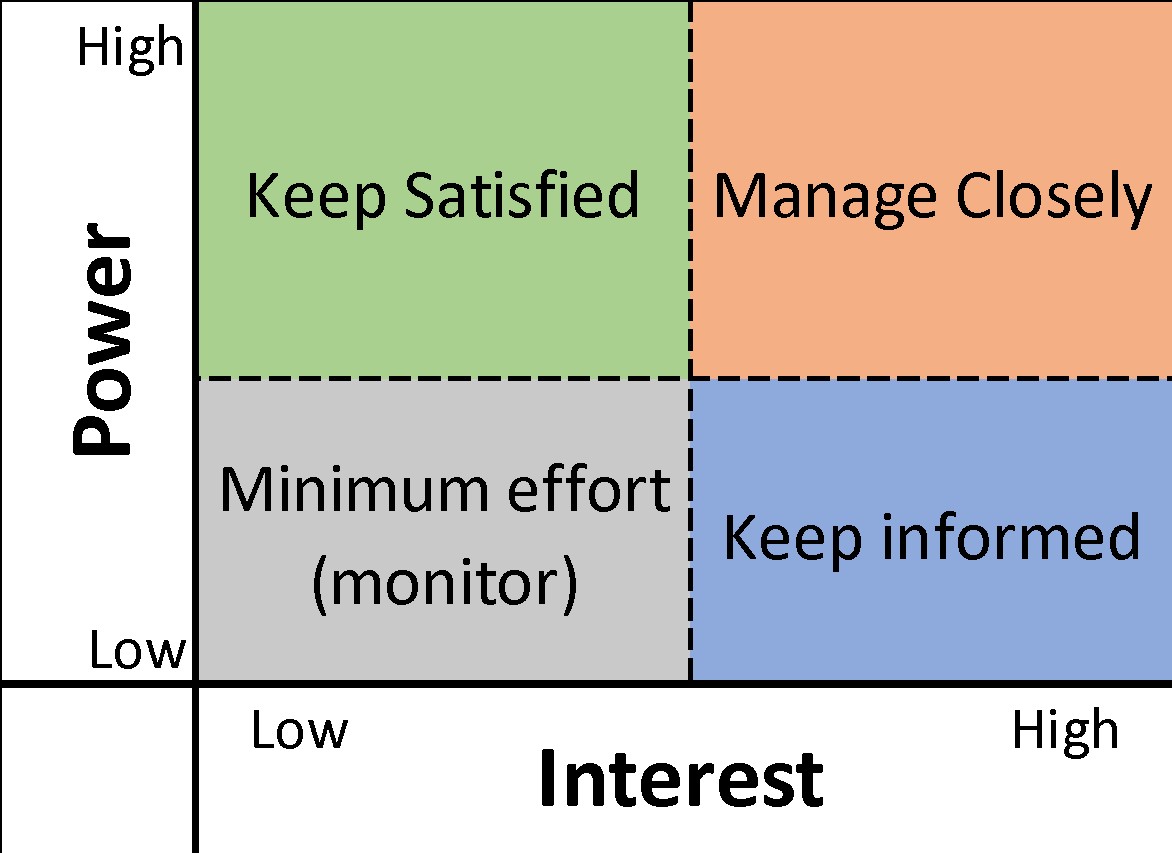
The table above aids in the management of stakeholders by identifying two additional groups besides the most ― Manage Closely ― and the least ― Minimum Effort ― significant ones. Keep Satisfied those with power but with no particular interest in your activities and Keep Informed who are interested but have no power.[1]
A basic categorisation of your stakeholders is necessary in order to know your obligations and predict their behaviour:
- Primary Stakeholders are those with a core interest. This group is usually called the target group or the main customers such as members, volunteers, users of services, important trading partners.
- Secondary Stakeholders often function as a bridge between the company and primary stakeholders. They are usually, banks, suppliers, network partners, public/private sector organisations and competitors.
- Tertiary Stakeholders the existence and proportion of this category depends on the size of the enterprise. From financial institutions to external consultants and one-off suppliers many can be listed here.
Summary:
Planning as a social entrepreneur is vital in the success of your business. After finding a market niche think in advance and try to count for every obstacle in a form of expense. However do not shy away even if your plans show losses in the first 2-4 years. Remember that investment precedes income, and it takes a while to generate a profit, but you are only able to support your ideas in front of your stakeholders with a well thought-out plan. Also, a social enterprise has plenty of opportunities to raise finance and to fund its expansion by applying for tenders or receiving gifts, which are less viable for common for-profit businesses.
[1] For further information visit: Mind Tools
[1] For more visit: Share capital (Wikipedia) and Investopedia
[2] European Social Fund Plus (ESF+)
[3] ESF Social Innovation+ | European Social Fund Plus, the latest call is available here
[4] European Regional Development Fund
[5] Inforegio – EU Regional Policy – Regional Policy – European Commission (europa.eu)