Curriculum
MODULE 2 - Defining your Social Business
Unit 1 – Business Model Canvas for social enterprises
0/8

Unit 2 - Finance & fundraising
0/13
Unit 3 - Legislation
0/1
Unit 4 – Marketing for social enterprises in the field of gastronomy
0/8
Lesson
What is marketing?
Marketing is the activity of communicating, mediating and exchanging supply, targeted at customers or business partners. It involves selecting target markets, identifying, attracting, retaining and increasing the number of customers.
What can marketing be targeted at?
- Products,
- Services,
- Events,
- Organisations,
- Etc.
How to develop a marketing plan?
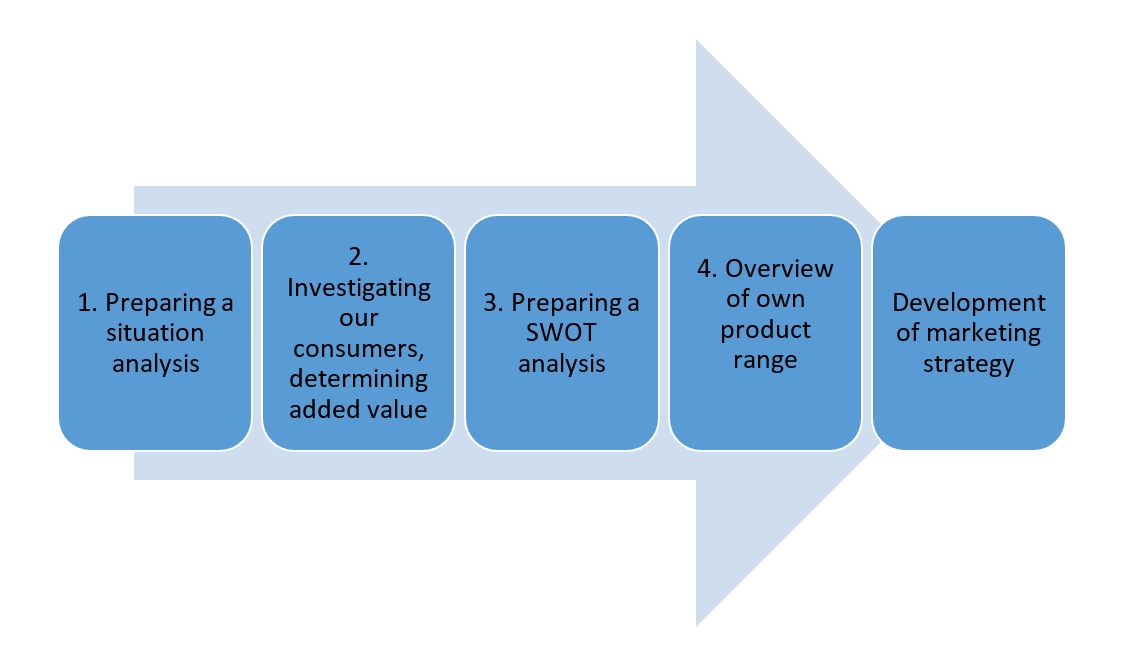
As a first step, it is proposed to prepare a situation analysis, based on information from previous market research. In the situation analysis, we will determine how our products/services are received based on feedback, who our customer base is, how it can be expanded, what our main sales channels are, how effective they are at the moment.
We then look at our customers in more detail. The more precise the description of the target audience, the better targeted the messages we can send to them. If possible, it is worth identifying their demographic data (gender, age, education, consumer habits, consumer behaviour, etc.).
Market needs must also be examined during the planning process, by identifying benefits and values that are important to our customers and consumers, e.g.:
- Products made from organic/bio ingredients,
- Wide, consumer-friendly access,
- Well thought-out packaging (recyclable, biodegradable, packaging-free, etc.).
These added values will form the basis of our marketing message, which will be easy to incorporate and use in our communications, and will also help us to identify the key advantages that will make our product or service stand out from the other competitors.
To further inform your planning, you can carry out a simple SWOT analysis using the following table:
| Strengths
Internal factors that are positive for you, your team, and your product/service. |
Weaknesses
Internal factors that are specific to you, your team, your product/service, areas for improvement, negatives. |
| Opportunities
External factors that you can harness for success. |
Threats
External factors that can negatively affect the success of your activities. |
Overview and evaluation of our own product range:
As a next step, consider what products and/or services you offer, which of these are/may be your main source of revenue, and what value they add to your customers that differentiates them from your competitors in the market.
The key to success will be to produce products and services that can respond to real market needs.
Develop a marketing strategy
We need to define the marketing objectives for which we want to carry out marketing activities, e.g:
- To promote our products/services as widely as possible,
- To increase market coverage,
- Promote our organisation,
- Launch of our new organic product range,
- Etc.
We can then outline our marketing programme based on four main elements:
- Pricing: based on the price at which a consumer can buy a product or service from us. It is best to set a lower price at the outset as a new entrant or when launching a new product and to incorporate this into our communications. As our customers become more familiar with the products, the price can be increased.
- Choosing a sales channel: we should aim to choose a sales channel through which we can actually reach our customers. If your target group prefers online shopping, then you should build your business idea around that, but it may also be that they prefer face-to-face sales, e.g. fairs or local stores. It is always a good idea to address this question when surveying your target audience.
- Advertising and promotion: we need to define the specific media platforms that will be used to promote our organisation and the products/services it offers. It is worth thinking about both online and offline options, taking advantage of services that are free or available at a significantly reduced cost.
- Customer service: satisfied customers become returning customers. We must make sure that the buying process does not end when the product/service is paid for. To keep satisfied customers coming back to us, we need to address their problems, respond to their needs and questions, even by running a simplified customer service.
We need to continuously monitor the marketing activities we implement, with regard to the time, cost and return on investment. It is also worth creating a database to compare the effectiveness of each channel.
Easily available marketing tools for social cooperatives:
Website/blog:
An effective way to promote your organisation, products/services and communicate with your customers is to have your own website or blog. There are a number of free or low-cost options that require no significant expertise, just an investment of time. Most people use the Internet for their information and will tend to find vendors and service providers more credible if they can find information on them in the form of a website or blog. If it fits our profile, the website can be linked to a webshop or we can periodically publish specific content on our blog that fits our profile. The latter option should only be chosen if you can run it on an ongoing basis. A blog that is not regularly updated may have a negative impact on our target group.
Social media:
Our profiles on social media sites offer us many opportunities. They help us to quickly connect with our customers and potential customers from the very beginning. For example:
- To promote your organisation,
- To assess consumer needs,
- Market research,
- To measure satisfaction
- To provide quick information,
- Discounts, games, promotions,
- New product launches,
- Etc.
YouTube:
If you have the opportunity, it’s worth making a vlog or a mini promotional video related to your business. You don’t need a big crew, you can create quality content with a smartphone. For example, a short video about your social enterprise can be embedded in the website, potential customers will get to know the “face behind the business” and a more personal approach will help to build a positive image.
Dissemination on related online platforms
In building our relationships, we should look for partners and identify opportunities to help us promote our organisation and our activities on their own online platforms, websites and blogs. This could be in the form of a PR article, but if we are talking about a business partner, we could even do some mutual advertising. The aim is to appear in as many places as possible that our target group is likely to visit.
Sending newsletter:
When conducting market research on social media platforms, we may collect the email addresses of our potential target group, of course in compliance with the relevant GDPR rules and only with their consent. This allows us to send them regular newsletters about our latest news, discounts, competitions, etc.
SEO:
When building a website, it’s a good idea to take the time to optimise it effectively for search engines. It makes a difference how high your organisation appears in search engines for a particular keyword.
Offline opportunities:
Events – this could be fairs, trade events, conferences, the idea is to raise your profile and help you reach your target audience or business partners.
Use of traditional media platforms – if your target group does not have an active online presence, it is advisable to use traditional media platforms for your presence. These are often costly, but we can benefit from being a social enterprise and therefore have access to discounted or even free opportunities. When choosing the media, it is important to consider the information habits of your target audience (e.g. do they prefer print media, leaflets, etc.).
Creating the marketing message:
The message conveyed by our marketing activities is good if it differentiates our product/service from competitors in the market, highlights the values and motivates consumers to take action. The message usually includes a promise of what the consumer will get in return for the purchase. It is very important, however, that this should not be an empty promise, and that credibility should always be sought.
What can be value to the buyer?
- High product quality,
- Uniqueness,
- High quality service environment,
- Quality of service,
- Positive social impact,
- Environmental awareness,
- Etc.
As a social enterprise, it is important for us to emphasise as part of our marketing activities that our organisation, and thus our products and services, represent high quality, and that we also take social responsibility.
Evaluation of our marketing activities:
It is useful to review our marketing activities on a monthly basis. Answering a few simple questions will help us to assess effectiveness, e.g.:
- Have we achieved our objectives?
- Have our customers and clients increased? Have we achieved our targets and customers?
- Are we more active on social media? Has the website traffic increased?
- Is there a change in our sales revenue?
- Etc.
The evaluation doesn’t have to be a complicated process, the aim is to get a realistic picture of whether the marketing channels used are appropriate at all, whether we have reached our target group, whether we have conveyed the right message to them. If a few months of active marketing in a row are not delivering the expected results, it is worth considering where we need to adjust our strategy.