Curriculum
MODULE 1 - Inspiration for Social Entrepreneurship
Unit 1 - What is a social enterprise and what does it simply setting up one?
0/11
-
Unit 1 - Details
 Trial
Trial -
Case Study
Trial
-
Lesson - What is a social enterprise?
Trial
-
Lesson - 6 Principles of Social Business
Trial
-
Lesson - What is a difference between these three?
Trial
-
Lesson - How to Start a Social Enterprise?
Trial
-
Tips & Tricks
Trial
-
Important concepts/definitions
Trial
-
Self-reflective questions
Trial
-
You may also be interested in this/ Additional useful resources
Trial
-
References
Trial
Unit 2 - Identifying opportunities in empty Europe related to gastronomy
0/8
Unit 3 - Ideation of the product & service related to gastronomy
0/12
Unit 4 – Market analysis
0/8
Lesson – What is a social enterprise?
There is no uniform language and understanding around the idea of social enterprise. Many definitions exist and a wide variety of organisational forms are adopted by social enterprises around the world.
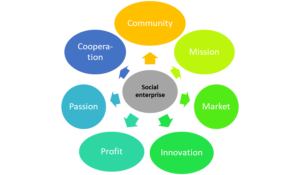
Generally speaking, “social enterprise” means using business tools to address a social need.
The Organisation for Economic Co-operation and Development (OECD) defines social enterprises as “any private activity conducted in the public interest, organised with an entrepreneurial strategy, but whose main purpose is not the maximisation of profit but the attainment of certain economic and social goals, and which has the capacity for bringing innovative solutions to the problems of social exclusion and unemployment” (OECD, 1999).

More recently, the European Commission has defined a social enterprise as being “an operator in the social economy whose main objective is to have a social impact rather than make a profit for their owners or shareholders. It operates by providing goods and services for the market in an entrepreneurial and innovative fashion and uses its profits primarily to achieve social objectives. It is managed in an open and responsible manner and, in particular, involves employees, consumers and stakeholders affected by its commercial activities” (Communication from the Commission, 2011/682 final).
NESsT, an international professional support organization that has been dealing with comprehensive and complex assistance to social enterprises for a decade and a half, uses the term social enterprise, taking into account European standards, as follows:
“… social enterprise is a consciously planned entrepreneurial activity created to solve social problems in an innovative way. Social enterprises can be non-profit organizations that use business models to achieve their core mission, and they can be businesses that pursue a significant social impact in addition to their business purpose. Their basic principle is double optimization, which means coordinating and balancing economic and social goals. ”
Most of the definitions define social enterprises as non-profit. Ont he other hand the law does not exclude for-profit enterprises either, and the international trend clearly points to the proliferation of for-profit social enterprises (Chhabra, 2015). Typical examples of this are social enterprises that want to help the long-term unemployed or disadvantaged people for example by running a restaurant that not only provides food to disadvantaged people, but also provides them with work and thus income.
In Europe, the social economy gathers entities such as co-operatives, associations, mutuals and foundations. Social enterprises take various legal forms in different countries across Europe. These forms include solidarity enterprises, co-operatives or limited liability social co-operatives, collective interest co-operative. A review of the legal structures and legislation in a number of European countries that have adopted national laws regulating social enterprises reveals that these laws address common issues including the definition of social enterprise; asset allocation; stakeholder and governance systems; and, accountability and responsibility towards internal and external stakeholders. These national laws provide different legal solutions based on specific cultural contexts.
A distinction must also be made between ‘real’ social enterprises and those operating mainly in the business sector, whose mission and / or main business objectives include sustainability, environmental protection, expanding employment or improving the quality of social benefits. This is the area of corporate social responsibility, CSR (Győry, 2010).
In Europe, social enterprises are active in a wide spectrum of activities and in many different fields, including social services, education, housing, the environment, culture and the arts, and tourism, through new activities such as renewable energies, fair trade and transport.
Examples of successful social enterprises can be found here: CASE STUDIES
The main criterion for social enterprises is real value creation: in the interests of sustainability, it is important that they are created to serve real market needs in addition to the social goal (for example, the employment of people with disabilities) and offer quality, competitive products and services.