Curriculum
MODULE 1 - Inspiration for Social Entrepreneurship
Unit 1 - What is a social enterprise and what does it simply setting up one?
0/11
Unit 2 - Identifying opportunities in empty Europe related to gastronomy
0/8
Unit 3 - Ideation of the product & service related to gastronomy
0/12
-
Unit 3 - Details
 Trial
Trial -
Case Study
Trial
-
Lesson - What does ideation mean
Trial
-
Lesson - The ideation process
Trial
-
Lesson - Creativity techniques
Trial
-
Lesson - Ideating your own product/service
Trial
-
Lesson - Ideating & Co-creating your idea with others
Trial
-
Tips & Tricks
Trial
-
Important concepts/definitions
Trial
-
Self-reflective questions
Trial
-
You may also be interested in this/ Additional useful resources
Trial
-
References
Trial
Unit 4 – Market analysis
0/8
Lesson – Creativity techniques
Creativity techniques are the perfect tool in the process of thinking about your social product or business adventure, designing it or developing new approaches within your social enterprise, so they are also essential to keep your business innovative and competitive. They enable organizations or individuals to stimulate the development of ideas as a source of innovation.
Use the techniques to turn the idea into a great product or service, use them to generate many ideas, to reflect and assess them and decide which one will be the baseline of your business. You can use the creativity techniques to generate completely new ideas from scratch, but do not be afraid to turn around old or existing ideas. A new idea can be innovating in an old one by adding on additional value, features or applying it in another sector. But remember, do not copy the idea of someone else, it can hardly become a successful business.
When deciding which ideation techniques to use, think about the nature of your design problem, as well as the people taking part in the ideation session. It’s important to choose techniques which are suitable for the group size. At the same time, consider which methods are most likely to put your participants at ease and elicit the best response among this particular group of people.
There is a huge pool of creativity techniques that you can use to generate new ideas and find solutions to problems or challenges, at any stage of your entrepreneurial venture. Here are some of the most common ones.
- Brainstorming / Brainwriting
– This type of ideation technique, normally developed during group sessions, allows a large number of ideas to be collected in a short space of time. During these processes the quantity of ideas is valued more than the quality of them, so it is advisable not to judge one’s own or others’ ideas in the first instance. The main difference between a brainstorming and a brainwriting is that the latter technique is done in writing, organized in different rounds in which participants write down their ideas on paper and then exchange roles with other participants. For this reason, it is more advisable to encourage the participation of more introverted members. There are different brainwriting techniques, with Method 6-3-5 being one of the most popular.
-
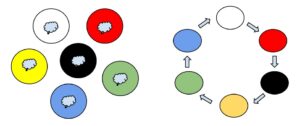
Six Thinking Hats
– it is specially designed to analyze a problem or challenge from all possible perspectives, in order to analyze the situation and produce innovative and favorable solutions. The hat metaphor works nicely because it is easy to take off or put on a hat, thereby allowing that person to change hats and think about the issue from yet a different perspective.
-
SCAMPER
– This technique is based on the premise that any product/service/experience can be subjected to an innovation process by asking the following questions about it:
- Substitute: some of the elements or components of your business idea/product may be exchanged for another one that provides more value or, it is possible that your product or service can be applied in a different context than the one initially proposed.
- Combine: what if you combined purposes or objectives of the product, solution, idea?
- Adapt: assess the possibilities that your offer can be adapted to other contexts, target groups, etc. Can you find another use for your product/service? How could you better meet the needs of your target group?
- Modify: imagine all the possible changes and alterations you could apply to the appearance or communication of your product/service.
- Put to another use: perhaps by contextualising your business idea in a different industry, the needs and results would be different. Use these inputs to evaluate your idea from a different perspective.
- Eliminate: what factors can you eliminate to simplify your idea/product?
- Rearrange (or Reverse): what if you try the exact opposite of what you’re trying right now? Turn your idea 360º and reflect on it!
-
Lateral Thinking
– can be defined as the ability to think outside the box, i.e. a deliberate and systematic way of solving problems through an indirect and creative approach that involves looking at problems from diverse and unexpected angles and from completely different perspectives. It allows thinkers to discover novel solutions that would otherwise go unnoticed by introducing specific and unconventional thinking techniques. Lateral thinking is concerned with what might be rather than what is possible. In this sense, training our lateral thinking does not allow us to break free from our preconceived ideas and mental patterns, and it is specifically concerned with the generation of new perceptions, ideas, and creative solutions.
De Bono proposed four techniques for lateral thinking:
- Awareness – the author believed that we should first cultivate an awareness of how our minds process information. The first step toward greater innovation is to resist established patterns.
- Random stimulation – Being exposed to randomness is an important part of developing lateral thinking skills. We normally try to block out all distractions and focus our minds on the task at hand, but de Bono contends that allowing in a variety of information–by going for a walk, listening to a podcast, talking to a stranger, or taking a different route to work–can positively impact our problem-solving process.
- Alternatives – The third technique is to consider alternative solutions on purpose. Maybe you’ve decided on what you believe is the best solution to your problem, but de Bono encourages us to think about other possibilities. It is, in his opinion, the only way to truly consider the problem. From his perspective, the only way to truly consider the problem is from all its angles.
- Alteration – Reversing the relationship between parts of a problem, going in the opposite direction of what is implied, breaking patterns down into smaller pieces, and translating relationships into analogies and then back are all ways to cultivate a “alteration mindset” while problem solving.
-
Five Ws and H
– This technique seeks to gather information on a specific topic or problem by answering the following questions: what?, when?, where?, who?, why?, and how? The answers cannot be “yes” or “no”, but must be argumentative answers that provide useful data for finding a solution to the problem, devising a new social enterprise, as is the case, or structuring a compelling narrative. It can be used by individuals as well as groups. Brainwriting and brainstorming can be used in groups to generate answers to questions. Brainwriting – the team gathers around a table and passes around six sheets of paper labeled “What?” “Why?” When? Who? How? Where? Person “A” begins with the sheet “What,” Person “B” begins with the sheet “Why,” Person “C” begins with the sheet “When,” and so on. Brainstorming entails the facilitator asking questions and writing down the answers.
-
Analogies
– is used to investigate unrelated ideas in order to gain new insights into your design problems. These insights may assist you in reshaping a well-known concept into something entirely new in a new context. Analogies force the design team to think on a different level, which aids in the discovery of new inspiration and ideas for a specific concept. Analogies can assist the team in seeking inspiration for problem-solving as well as redesigning the design problem to generate novel design solutions. To generate analogies, follow these six simple steps: 1) Identify the characteristics of your problem scenario, 2) Look for similar objects and their behaviors, 3) Look at an industry that is completely different from yours, 4) Look for specific people you could interview, 5) Use brainstorming techniques, and 6) Create an analogous inspiration board.
-
Challenging Assumptions
– It is beneficial to think twice about the features and functionalities of a product or service for which you are looking for a solution. The questions you ask may seem silly, but they will force you and your team to think about it from a new angle and come up with an even better solution! This technique can be completed in three simple steps: 1) Make a list of assumptions, 2) challenge the assumptions, and 3) figure out how to make the challenge a reality.
-
Mindmapping
– A mind map is a diagram which contains words, concepts or ítems arranged around a central concept. It visually structures ideas to aid in analysis, and turn long lists of information into a more visual, organised and colourful representation. It uses Organical brainstorming and is unstructured and without order. The key challenge is places in the middle of the paper after which ideas that come to mind are written down and connections made. Some online tools such as MIRO may be useful for collaborative mind mapping in a digital environment.
-
Worst possible idea
– This technique is carried out by generating the worst possible idea or solution for the current design problem. By coming up with the worst possible idea, you will relieve participants’ pressure to come up with a great idea. As you can see, no one will judge you if you come up with incorrect and impossible ideas. As a result, it relieves stress and anxiety and boosts a person’s confidence to speak up. It could be also used as an ice-breaker activity in order to create a safe and comfortable space for participants to speak their minds in further steps of the ideation process.
This set of techniques is only an approximation of the tools you can use. Feel free to explore other creativity techniques and try out the ones you find most appropriate for your needs. Don’t be afraid to experiment with them – the more ideas you come up with, the more chances you have to generate a brilliant idea for your social enterprise!